


Entering the world of forex trading can feel exciting, fast-paced, and full of opportunity. Every day, thousands of people start their trading journey hoping to achieve financial freedom, create a side income, or eventually trade full-time. However, most beginner traders quickly discover that trading is much harder than it looks on social media.
The truth is that beginner trading is not only about learning charts and indicators. It is also about discipline, emotional control, patience, and proper risk management. Many new traders fail not because they lack intelligence, but because they repeat the same common trading mistakes over and over again.
In this article, we’ll explore the biggest challenges beginner traders face in forex trading, the mistakes that often lead to losses, and how you can build consistency and improve your overall trading performance.
Why Beginner Traders Struggle in Forex Trading
Forex trading offers high liquidity, flexible trading hours, and the ability to start with relatively small capital. These advantages attract many new traders. Unfortunately, beginners often enter the market with unrealistic expectations.
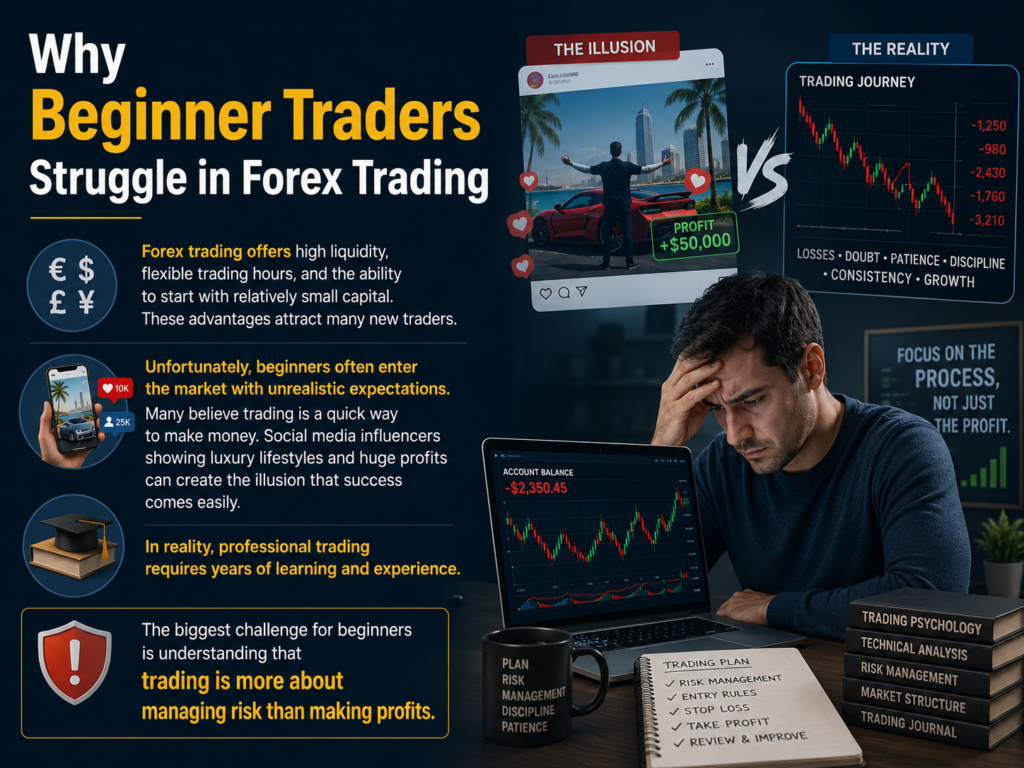
Many believe trading is a quick way to make money. Social media influencers showing luxury lifestyles and huge profits can create the illusion that success comes easily. In reality, professional trading requires years of learning and experience.
The biggest challenge for beginners is understanding that trading is more about managing risk than making profits.
The Most Common Trading Mistakes Beginners Make
1. Trading Without a Plan
One of the biggest beginner trading mistakes is entering trades without a clear strategy.
Many new traders open positions based on emotions, random signals, or social media tips. Without a trading plan, decisions become inconsistent and emotional.
A proper trading plan should include:
- Entry rules
- Exit rules
- Risk management
- Position sizing
- Trading schedule
- Profit targets
- Maximum daily loss
Without structure, trading becomes gambling.
How to Avoid This Mistake
Create a simple but clear trading plan before entering the market. Test your strategy on a demo account first and focus on consistency rather than quick profits.
2. Risking Too Much Money Per Trade
Another major mistake in forex trading is over-risking.
Many beginners risk large portions of their account on a single trade because they want fast results. While this may occasionally lead to big wins, it often ends in blown accounts.
Professional traders understand that protecting capital is the top priority.
A common rule in risk management is risking only 1%–2% of your account per trade.
For example:
- If your account is $1,000
- Risking 1% means losing only $10 maximum on one trade
This allows traders to survive losing streaks and continue improving.
3. Overtrading
Overtrading happens when traders take too many trades unnecessarily.
This usually happens because of:
- Revenge trading after losses
- Fear of missing out (FOMO)
- Boredom
- Addiction to market activity
Many beginners believe more trades equal more profits. In reality, quality matters far more than quantity.
Professional traders often wait patiently for high-probability setups.
Signs You Are Overtrading
- Taking trades outside your strategy
- Constantly checking charts
- Feeling emotionally exhausted
- Entering trades impulsively
- Trading immediately after losses
Solution
Focus on patience and discipline. Remember that not trading is sometimes the best decision.
4. Ignoring Risk Management
Risk management is one of the most important skills in forex trading, yet beginners often ignore it completely.
Common risk management mistakes include:
- Trading without stop loss
- Increasing lot sizes emotionally
- Holding losing trades too long
- Using excessive leverage
Without risk management, even a good strategy can fail.
Successful traders understand that losses are normal. The goal is not to avoid losses completely but to keep them small and controlled.
5. Letting Emotions Control Decisions
Emotions are one of the biggest obstacles in beginner trading.
Fear and greed can cause traders to abandon their plans and make irrational decisions.
Fear Causes Traders To:
- Exit winning trades too early
- Avoid valid setups
- Hesitate during entries
Greed Causes Traders To:
- Overtrade
- Increase position size recklessly
- Hold trades too long
Emotional trading often leads to inconsistent performance.
How to Improve Emotional Discipline
- Use a trading journal
- Follow fixed risk rules
- Take breaks after losses
- Avoid staring at charts all day
- Focus on long-term consistency
6. Expecting Instant Results
Many beginner traders expect to become profitable within weeks or months.
This unrealistic expectation creates frustration and emotional pressure.
Forex trading is a skill-based profession similar to learning a sport or business. Consistency takes time.
Professional traders spend years refining their strategies, understanding market behavior, and mastering psychology.
The Reality of Trading
Success in trading usually comes from:
- Repetition
- Experience
- Discipline
- Continuous learning
- Risk control
The traders who survive long-term are the ones willing to stay patient during the learning process.
7. Constantly Changing Strategies
Another common trading mistake is strategy hopping.
Many beginners switch strategies after only a few losses. They move from one indicator to another, hoping to find a “perfect strategy.”
The truth is that no strategy wins 100% of the time.
Even profitable systems experience losing streaks.
Why Strategy Hopping Is Dangerous
- Prevents mastery
- Creates confusion
- Reduces confidence
- Leads to inconsistent execution
Instead of searching endlessly for a perfect strategy, focus on mastering one proven system.
8. Using Too Many Indicators
Charts overloaded with indicators can confuse beginner traders.
Some traders use:
- RSI
- MACD
- Bollinger Bands
- Moving averages
- Fibonacci
- Stochastic
- Multiple custom indicators
Using too many tools often creates conflicting signals and analysis paralysis.
Keep It Simple
Simple trading systems are often more effective.
Many successful traders rely mainly on:
- Market structure
- Support and resistance
- Trend analysis
- Price action
Clarity improves decision-making.
9. Not Keeping a Trading Journal
A trading journal is one of the most underrated tools for improvement.
Without tracking trades, beginners repeat the same mistakes without realizing it.
A good trading journal should record:
- Entry and exit points
- Risk amount
- Emotions during trades
- Reasons for taking trades
- Lessons learned
Over time, patterns become visible.
This helps traders identify weaknesses and improve consistency.
10. Following Other Traders Blindly
Many beginners rely entirely on trading signals or influencers.
While learning from experienced traders can help, blindly copying trades is dangerous.
Why?
Because you may not understand:
- Their strategy
- Their risk tolerance
- Their market conditions
- Their account size
Successful traders develop independent thinking and confidence in their own systems.
The Psychological Challenges of Beginner Trading
Forex trading is as much mental as technical.
Many beginners underestimate the psychological pressure of risking money.
Some common psychological challenges include:
- Fear of losing
- Fear of missing out
- Impatience
- Revenge trading
- Lack of confidence
Developing the right mindset is critical for long-term success.
How to Build Consistency in Forex Trading
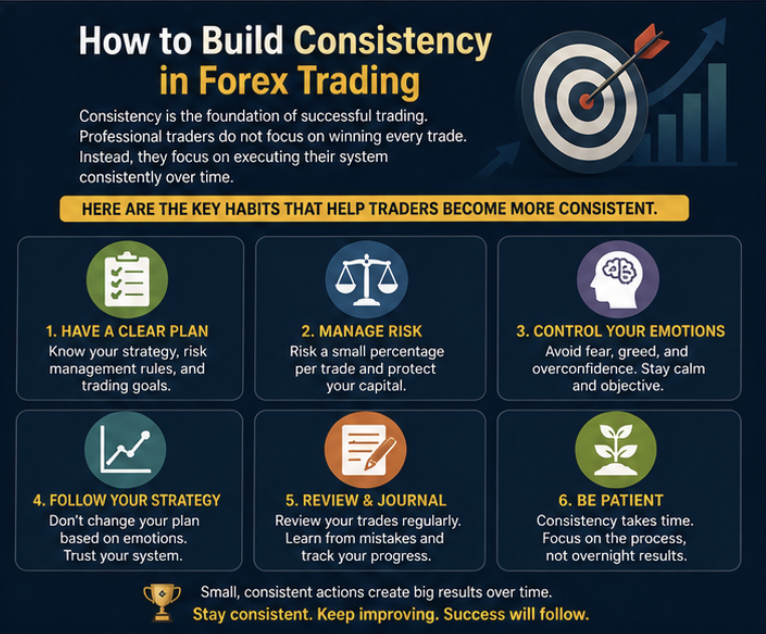
Consistency is the foundation of successful trading.
Professional traders do not focus on winning every trade. Instead, they focus on executing their system consistently over time.
Here are the key habits that help traders become more consistent.
1. Focus on Process Over Profits
Beginners often obsess over money.
Professional traders focus on execution.
Instead of asking:
“How much money can I make today?”
Ask:
“Did I follow my trading plan correctly?”
Good processes eventually lead to better results.
2. Use Proper Risk Management
Risk management protects your account during losing streaks.
A trader who survives can continue learning and improving.
Consistency comes from controlling downside risk.
3. Trade Less, But Better
More trades do not guarantee more profits.
High-quality setups matter far more.
Patience is a competitive advantage in trading.
4. Accept Losses as Part of the Game
Losses are normal in forex trading.
Even the best traders lose trades regularly.
The difference is that professionals keep losses controlled and remain emotionally stable.
5. Continue Learning
Markets constantly evolve.
Successful traders continue studying:
- Market structure
- Psychology
- Risk management
- Macroeconomics
- Trading performance
Learning never stops.
Beginner Trading Tips for Long-Term Success
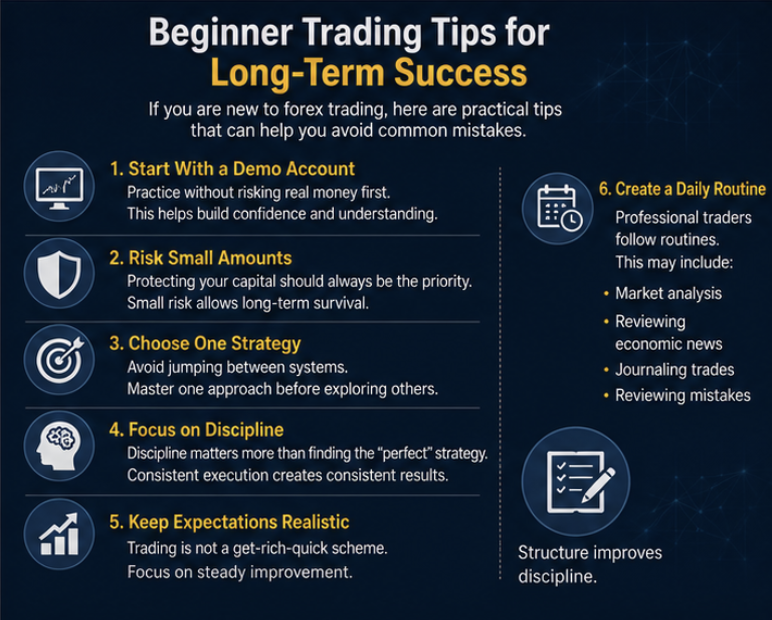
If you are new to forex trading, here are practical tips that can help you avoid common mistakes.
Start With a Demo Account
Practice without risking real money first.
This helps build confidence and understanding.
Risk Small Amounts
Protecting your capital should always be the priority.
Small risk allows long-term survival.
Choose One Strategy
Avoid jumping between systems.
Master one approach before exploring others.
Focus on Discipline
Discipline matters more than finding the “perfect” strategy.
Consistent execution creates consistent results.
Keep Expectations Realistic
Trading is not a get-rich-quick scheme.
Focus on steady improvement.
Create a Daily Routine
Professional traders follow routines.
This may include:
- Market analysis
- Reviewing economic news
- Journaling trades
- Reviewing mistakes
Structure improves discipline.
The Truth About Success in Forex Trading

Most successful traders are not successful because they predict the market perfectly.
They succeed because they:
- Manage risk well
- Stay emotionally disciplined
- Remain patient
- Follow their strategy consistently
- Learn from mistakes
The journey in beginner trading is not about becoming rich overnight.
It is about developing the habits and mindset required for long-term consistency.
Final Thoughts
Every trader makes mistakes in the beginning. The difference between successful traders and unsuccessful ones is the ability to learn, adapt, and stay disciplined.
Forex trading can offer incredible opportunities, but it also requires patience, emotional control, and proper risk management.
If you want to improve as a beginner trader, focus less on quick profits and more on building strong habits. Avoid common trading mistakes, protect your capital, and commit to continuous learning.
Over time, consistency and discipline can help transform beginner trading struggles into long-term trading growth.